
Start here: the intensive
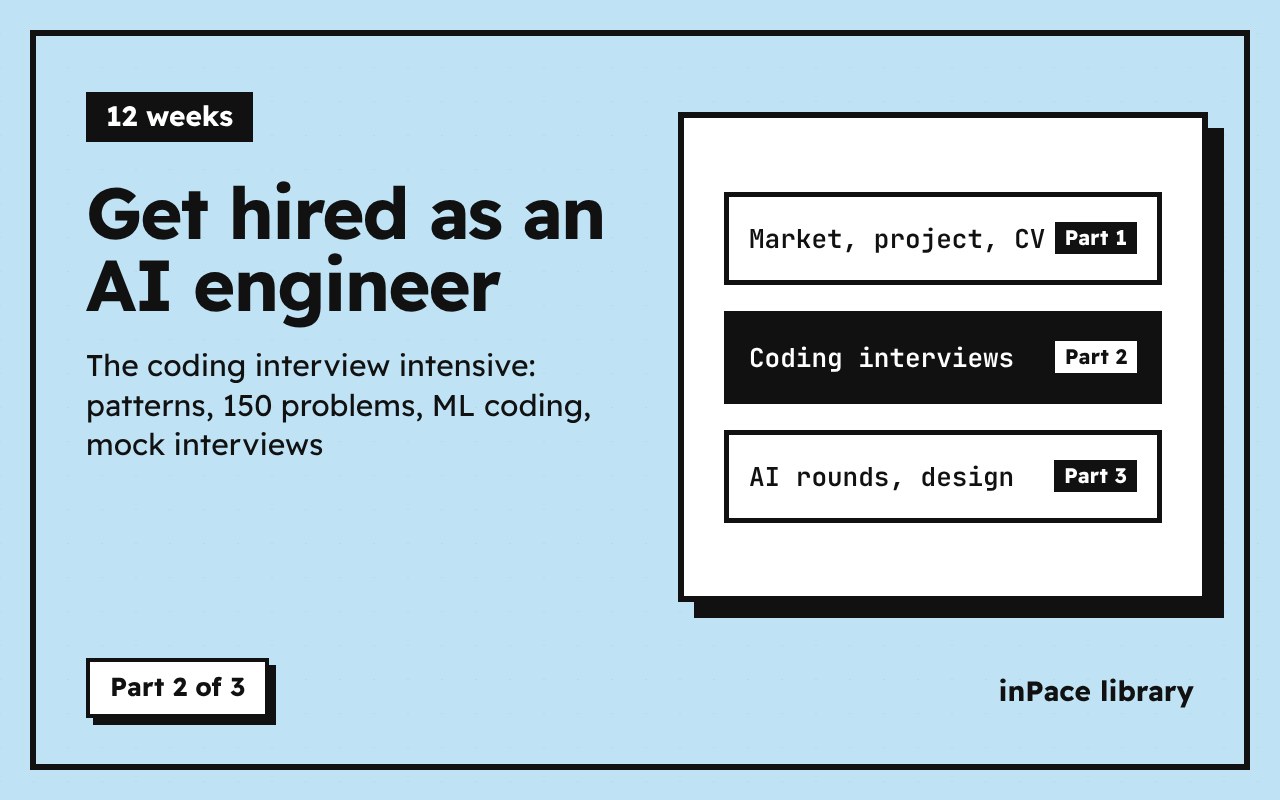
This is part 2 of Get hired as an AI engineer. It trains the round that rejects the most people: live coding. Expect about 10 hours a week for 12 weeks. It's hard on purpose: interviews are a skill, and skills come from many hours of the right practice, not from reading.
What AI engineer loops actually test
Alexey Grigorev's AI Engineering Field Guide studied the interview processes companies publish and candidates report. Coding shows up in two forms:
- Algorithm rounds (LeetCode-style): hash maps, tries, linked lists, graphs, greedy. Reported at Amazon, Databricks, IBM and others. The guide's advice: 75+ Easy and Medium problems.
- Implementation rounds (45 to 90 minutes): build something in layers, like a key-value store, a web crawler or an in-memory database, with new requirements arriving as you go. Reported at OpenAI and Anthropic.
- ML coding: for example cosine similarity in NumPy (Amazon), or logistic regression from scratch (Mistral).
This part covers all three: modules 2 to 10 are the algorithm patterns, module 11 is ML coding, module 12 is implementation rounds, and module 13 is mock interviews.
Your tracker
Make a spreadsheet now, one row per attempt: date, problem, pattern, minutes, solved alone (yes/no), key idea, redo date. It's how you'll see progress and choose what to redo. Language: use Python unless the job asks for another; its short syntax saves minutes in every interview.
Sources this part builds on
- Tech Interview Handbook by Yangshun Tay (author of the Blind 75 list), and its Grind 75 planner
- NeetCode roadmap and its free video solutions
- AI Engineering Field Guide for what AI companies ask