inPace
All coursesكل الدورات

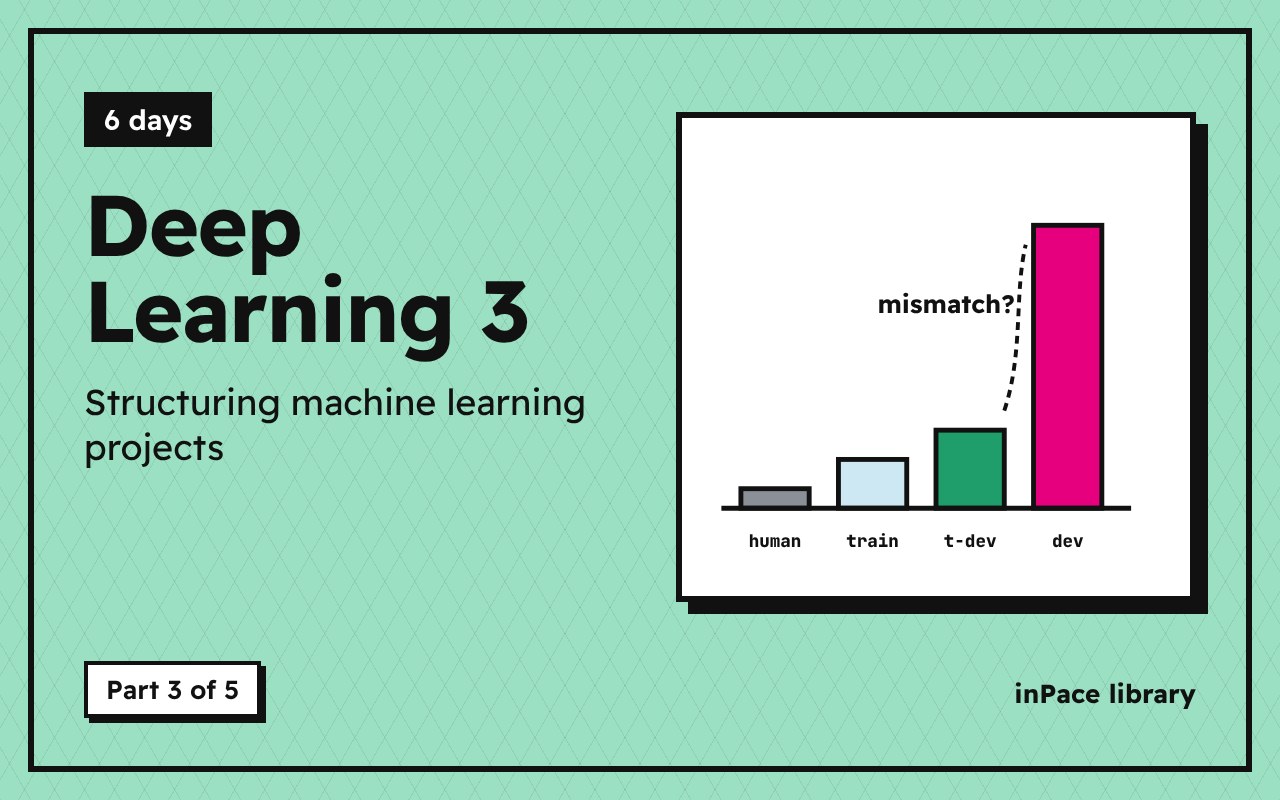
Deep Learning 3: structuring machine learning projects

  • about 6 h of lessonsحوالي 6 ساعة من الدروس
  • 6 modulesوحدات · 14 lessonsدروس
  • Englishالإنجليزية

Part 3 of a refresh of Andrew Ng's Deep Learning Specialization, with the original slides in each lesson: orthogonalization, single-number and satisficing metrics, dev and test sets, human-level performance and avoidable bias, error analysis, mismatched training data, transfer learning, multi-task and end-to-end learning, updated for the era of pre-trained models. One real project in a notebook you can open in Colab, download or read as a PDF. Plan: 6 days. Slides by DeepLearning.AI (CC BY-SA 2.0, non-commercial).

byمن إعداد inPace checkedموثّق

deep learningml strategyerror analysismlopspytorchandrew nginterview

On these roadmaps:ضمن هذه المسارات: Deep learning, with a machine learning refresh, Machine learning, from the maths up

What's insideمحتوى الدورة

Each module ends with tasks. The next module opens when they're done.تنتهي كل وحدة بمهام، وتُفتح الوحدة التالية عند إنجازها.

  1. Day 1: Orthogonalization and your goal 3 lessonsدروس · 60 min د
    • Start here10 min د
    • Why strategy, and orthogonalizationslidesشرائح25 min د
    • One number to optimize, and satisficing metricsslidesشرائح25 min د
    Practical taskمهمة عمليةExplain in your wordsاشرح بكلماتكQuizاختبار · 4 questionsأسئلة
  2. Day 2: Train, dev and test distributions 2 lessonsدروس · 55 min د
    • Choosing dev and test setsslidesشرائح30 min د
    • When to change the dev set or the metricslidesشرائح25 min د
    Practical taskمهمة عمليةExplain in your wordsاشرح بكلماتكQuizاختبار · 4 questionsأسئلة
  3. Day 3: Comparing to human-level performance 2 lessonsدروس · 60 min د
    • Human level, Bayes error and avoidable biasslidesشرائح35 min د
    • Surpassing human level, and improving your modelslidesشرائح25 min د
    Practical taskمهمة عمليةExplain in your wordsاشرح بكلماتكQuizاختبار · 4 questionsأسئلة
  4. Day 4: Error analysis and mismatched data 2 lessonsدروس · 65 min د
    • Carrying out error analysisslidesشرائح30 min د
    • Training and testing on different distributionsslidesشرائح35 min د
    Practical taskمهمة عمليةExplain in your wordsاشرح بكلماتكQuizاختبار · 4 questionsأسئلة
  5. Day 5: Transfer, multi-task and end-to-end learning 3 lessonsدروس · 75 min د
    • Transfer learningslidesشرائح30 min د
    • Multi-task learningslidesشرائح20 min د
    • End-to-end deep learningslidesشرائح25 min د
    Practical taskمهمة عمليةExplain in your wordsاشرح بكلماتكQuizاختبار · 4 questionsأسئلة
  6. Day 6: A real project, and interview drill 2 lessonsدروس · 65 min د
    • The project, end to end40 min د
    • Interview drill25 min د
    Practical taskمهمة عمليةExplain in your wordsاشرح بكلماتكQuizاختبار · 4 questionsأسئلة

Notebooks and downloadsالدفاتر والتنزيلات

They also come inside the course. Colab runs them free in your browser.وهي موجودة داخل الدورة أيضًا. يشغّلها Colab مجانًا في متصفحك.

Read a lesson firstاقرأ درسًا أولًا

Start here

Your plan

Days Module Slides
1 Orthogonalization and setting up your goal C3 week 1
2 Train, dev and test distributions C3 week 1
3 Comparing to human-level performance C3 week 1
4 Error analysis and mismatched data C3 week 2
5 Transfer, multi-task and end-to-end learning C3 week 2
6 A real project, and interview drill notebook

About 1 hour a day, for 6 days.

Code in this course is written for PyTorch 2.15 (October 2026), TensorFlow 2.21 and Keras 3.15. The slides use TensorFlow 1-style code in places; the notes show the current way.

How each lesson works: the slides for that part open at the top of the lesson. Read them, then the notes under them: the notes explain what the slide skips, show today's PyTorch and Keras code, and point to the experiments in the notebook. Notebooks are files that come with the course: open them in Google Colab (free, nothing to install), download them for Jupyter or VS Code, or read their PDF versions with all the outputs.

This is part 3 of 5: Structuring machine learning projects. No new network types: this is how to decide what to work on next, which is what separates fast teams from slow ones.

Credit: the slides are from the Deep Learning Specialization (course 3, Structuring Machine Learning Projects) by DeepLearning.AI, taught by Andrew Ng, shared under Creative Commons BY-SA 2.0 for non-commercial educational use. Take the full course on Coursera for the videos and graded labs.

Maths is written in plain text: W·x is a matrix product, Σ a sum, ^ a power, [l] the layer, (i) the example.

Licenseالرخصة: CC-BY-SA-4.0 · Updatedآخر تحديث 2026-11-13

Slides: Deep Learning Specialization by DeepLearning.AI (Andrew Ng), shared by DeepLearning.AI under Creative Commons BY-SA 2.0 for non-commercial educational use. Notes, notebooks, charts, tasks and questions: inPace.

Add to inPaceأضف إلى inPace