inPace
All coursesكل الدورات

Machine Learning refresh 2: neural networks, ML practice and decision trees

  • about 9 h of lessonsحوالي 9 ساعة من الدروس
  • 10 modulesوحدات · 19 lessonsدروس
  • Englishالإنجليزية

An advanced refresh of part 2 of Andrew Ng's Machine Learning Specialization, with the original slides inside each lesson: neural networks and forward propagation, TensorFlow, backprop, activations, softmax, Adam, bias and variance, learning curves, error analysis, transfer learning, precision and recall, decision trees, random forests and XGBoost, plus an interview drill. Plan: about 12 days, 1 to 1.5 hours a day. Slides by DeepLearning.AI (CC BY-SA 2.0, non-commercial).

byمن إعداد inPace checkedموثّق

machine learningandrew ngneural networksdecision treestensorflowinterview

On these roadmaps:ضمن هذه المسارات: Deep learning, with a machine learning refresh, Machine learning, from the maths up

What's insideمحتوى الدورة

Each module ends with tasks. The next module opens when they're done.تنتهي كل وحدة بمهام، وتُفتح الوحدة التالية عند إنجازها.

  1. Day 1: Neurons and layers 2 lessonsدروس · 45 min د
    • Start here10 min د
    • From biology to layersslidesشرائح35 min د
    Practical taskمهمة عمليةExplain in your wordsاشرح بكلماتكQuizاختبار · 4 questionsأسئلة
  2. Day 2: Forward propagation and TensorFlow 2 lessonsدروس · 60 min د
    • Forward propagation and inference in codeslidesشرائح35 min د
    • Forward propagation from scratch, and AGIslidesشرائح25 min د
    Practical taskمهمة عمليةExplain in your wordsاشرح بكلماتكQuizاختبار · 4 questionsأسئلة
  3. Day 3: Vectorization, and how backprop works 2 lessonsدروس · 55 min د
    • Matrix multiplication for whole layersslidesشرائح25 min د
    • Backpropagation without fear30 min د
    Practical taskمهمة عمليةExplain in your wordsاشرح بكلماتكQuizاختبار · 4 questionsأسئلة
  4. Day 4: Training a network and choosing activations 2 lessonsدروس · 55 min د
    • The three training stepsslidesشرائح25 min د
    • Activation functionsslidesشرائح30 min د
    Practical taskمهمة عمليةExplain in your wordsاشرح بكلماتكQuizاختبار · 4 questionsأسئلة
  5. Day 5: Multiclass, softmax, Adam and layer types 2 lessonsدروس · 55 min د
    • Softmax and its stable implementationslidesشرائح30 min د
    • Adam and other layer typesslidesشرائح25 min د
    Practical taskمهمة عمليةExplain in your wordsاشرح بكلماتكQuizاختبار · 4 questionsأسئلة
  6. Days 6-7: Evaluating models: bias, variance and learning curves 3 lessonsدروس · 70 min د
    • Train, cross-validation and test setsslidesشرائح25 min د
    • Diagnosing bias and varianceslidesشرائح30 min د
    • Learning curvesslidesشرائح15 min د
    Practical taskمهمة عمليةExplain in your wordsاشرح بكلماتكQuizاختبار · 4 questionsأسئلة
  7. Day 8: The ML development loop 2 lessonsدروس · 50 min د
    • Error analysis, more data, transfer learningslidesشرائح30 min د
    • The full cycle, and ethicsslidesشرائح20 min د
    Practical taskمهمة عمليةExplain in your wordsاشرح بكلماتكQuizاختبار · 4 questionsأسئلة
  8. Day 9: Skewed datasets: precision and recall 1 lessonsدروس · 30 min د
    • Precision, recall, F1 and thresholdsslidesشرائح30 min د
    Practical taskمهمة عمليةExplain in your wordsاشرح بكلماتكQuizاختبار · 4 questionsأسئلة
  9. Days 10-11: Decision trees and tree ensembles 2 lessonsدروس · 65 min د
    • Decision trees: purity and information gainslidesشرائح35 min د
    • Random forests and XGBoostslidesشرائح30 min د
    Practical taskمهمة عمليةExplain in your wordsاشرح بكلماتكQuizاختبار · 4 questionsأسئلة
  10. Day 12: Interview drill 1 lessonsدروس · 45 min د
    • 25 questions, short answers45 min د
    Practical taskمهمة عمليةExplain in your wordsاشرح بكلماتكQuizاختبار · 4 questionsأسئلة

Read a lesson firstاقرأ درسًا أولًا

From biology to layers

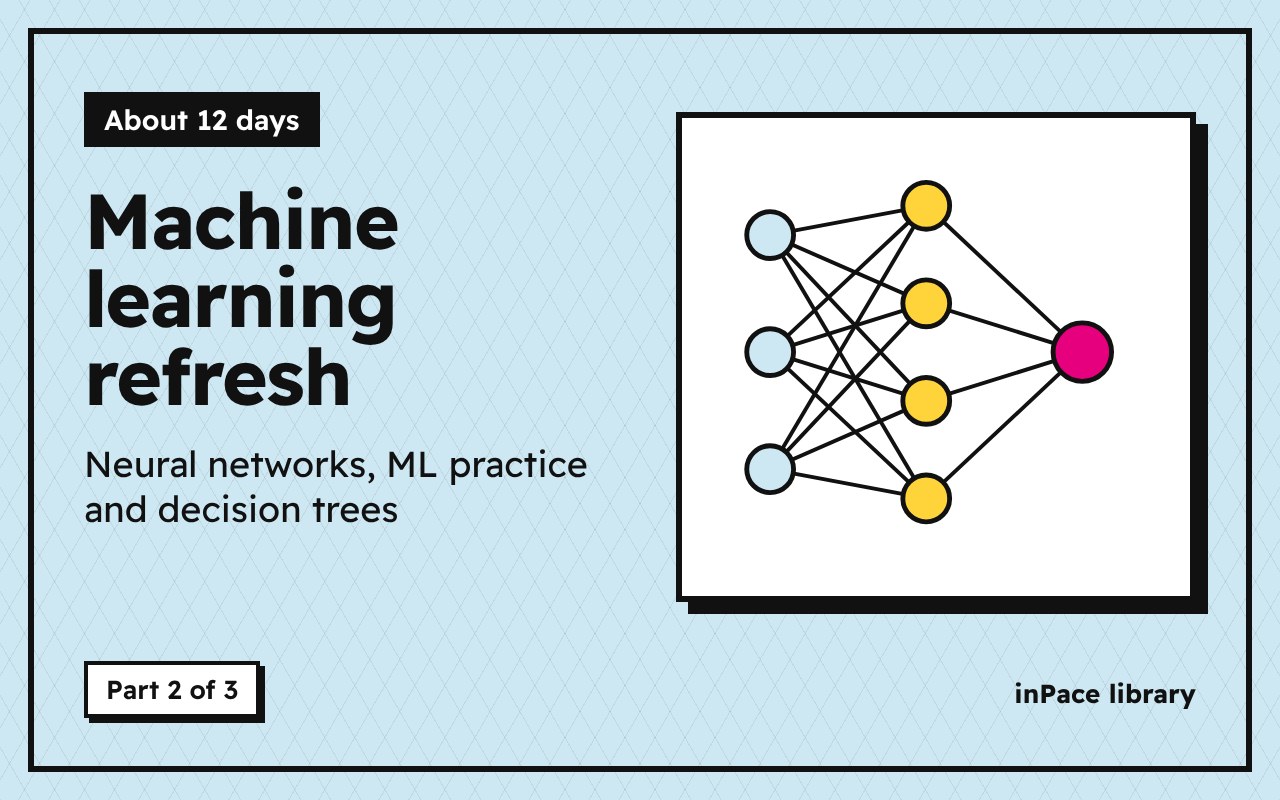
A neuron (unit) in a network is just logistic regression: a = g(w·x + b). A layer is many units reading the same input; a network stacks layers.

The demand-prediction example: inputs (price, shipping, marketing, material) → a hidden layer that learns "affordability", "awareness", "perceived quality" → output "will it be a top seller". The key idea: the network learns its own features. You don't design area = frontage × depth by hand any more.

Face recognition shows the same in images: early layers find edges, middle layers parts (eyes, noses), later layers face shapes.

Notation

  • a^[l] is the activation vector of layer l; a^[0] = x.
  • a_j^[l] = g( w_j^[l] · a^[l−1] + b_j^[l] ).
  • A network with 1 hidden layer is called a 2-layer network (the input layer doesn't count).

Going further

  • Universal approximation: one wide enough hidden layer can approximate any continuous function. Depth helps because many functions are far cheaper to represent with several layers than with one huge one.
  • Each unit's w_j is a learned feature detector; that's why networks beat hand-made features on images, sound and text.

Licenseالرخصة: CC-BY-SA-4.0 · Updatedآخر تحديث 2026-11-13

Slides: Machine Learning Specialization by DeepLearning.AI and Stanford Online (Andrew Ng), shared by DeepLearning.AI under Creative Commons BY-SA 2.0 for non-commercial educational use. Notes, questions and tasks: inPace.

Add to inPaceأضف إلى inPace