
Start here
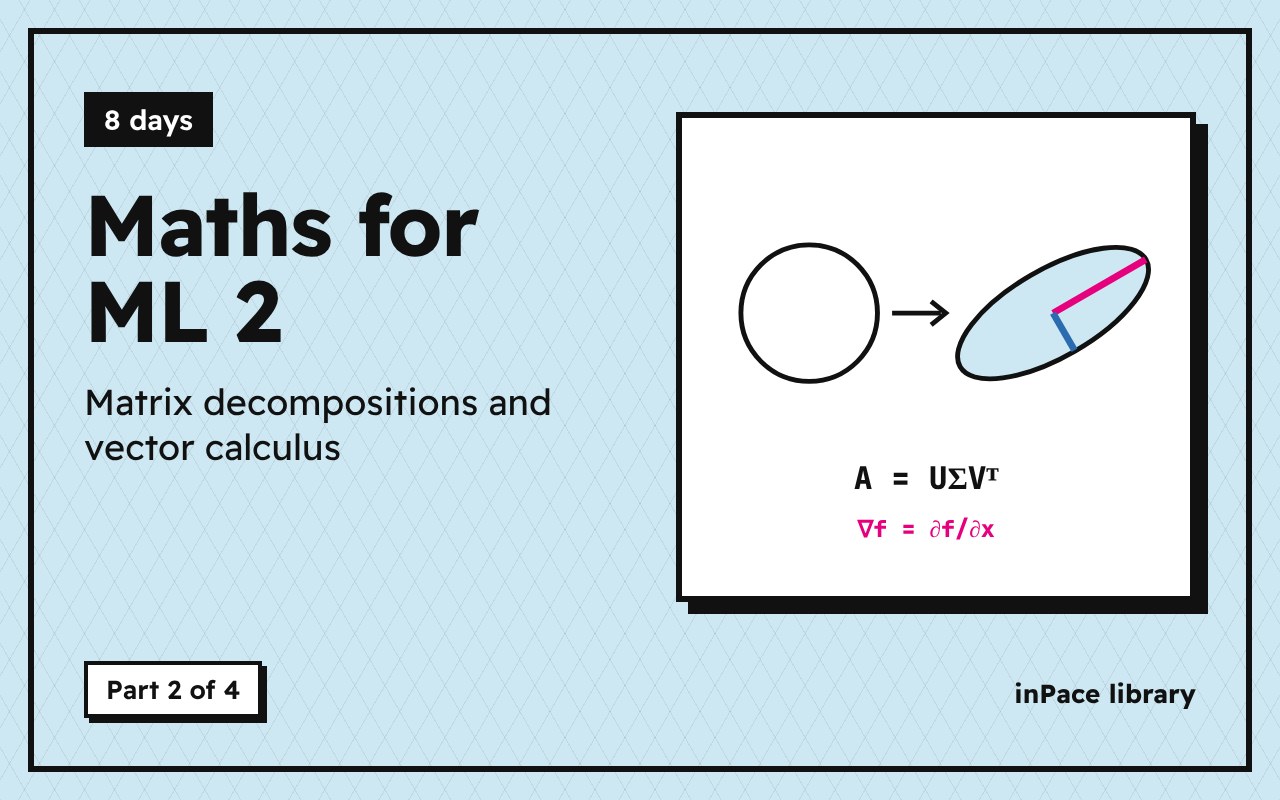
This is part 2 of 4 of Mathematics for Machine Learning: matrix decompositions and vector calculus (chapters 4 and 5). It assumes part 1 (vectors, matrices, rank, inner products, projections).
First, get the book (free)
This course follows Mathematics for Machine Learning by Marc Peter Deisenroth, A. Aldo Faisal and Cheng Soon Ong (Cambridge University Press, 2020). The authors give the PDF away for personal use, but it may not be shared, so it is not inside this course. Each lesson opens the right pages of your own copy.
- Download the PDF from mml-book.com (the link "PDF of the book").
- On this course's page, in the box "This course reads a book you get yourself", press Find it for me. inPace looks in your Downloads, Documents and Desktop folders (on a phone: Download, Documents, Books) and recognizes the book by its title and number of pages, whatever the file is called.
- If it's somewhere else, choose the folder or the file yourself.
If inPace warns that the page count is different, you have another printing: the lessons may open a page or two off. The course expects the 412-page PDF from mml-book.com.
Using an older inPace? Before 1.20, rename the file to mml-book.pdf and put it in this course's folder. Before 1.21,
the optional task and explanation still count as required. Updating inPace fixes both.
Your plan
| Days | Module | Book |
|---|---|---|
| 1 | Determinant and trace | 4.1 |
| 2 | Eigenvalues and eigenvectors | 4.2 |
| 3 | Cholesky and eigendecomposition | 4.3–4.4 |
| 4 | Singular value decomposition | 4.5 |
| 5 | Matrix approximation and the big picture | 4.6–4.8 |
| 6 | Derivatives, partial derivatives and gradients | 5.1–5.2 |
| 7 | Gradients of vectors and matrices | 5.3–5.5 |
| 8 | Backpropagation, Hessians and Taylor series | 5.6–5.9 |
About 1 to 1.5 hours a day, for 8 days. The SVD (day 4) and matrix gradients (day 7) are the hardest; plan an extra day for either if you need it.
How each module works
- Read lessons open the book at the right pages, with notes under them: what matters most, what to skim, and the intuition behind the formulas. Read with a pencil. The book's examples are worth redoing by hand.
- Watch lessons play a 3Blue1Brown video that shows the same idea moving. Watch it before or after the reading, whichever you like.
- Explore lessons are small interactive pages: drag, slide and see the math change.
- Check yourself pages give you exercises with instant feedback and worked answers. They don't count for anything.
- Each module ends with a quiz you need 70% to pass to open the next module. There's also a task and a short explanation in your own words: they're optional, but doing them is the best way to make it stick.